


Arrow Dash Cash
0.00.00 Reviews
App Specs
- Version
- 202600701-1723
- Updated On
- License
- Free
- Downloads
- 100,000+
- Developer
- Kashif Iqbal
- Categories
- Casual
- Platform
- Android
Screenshots
 Analysis by AppCompare
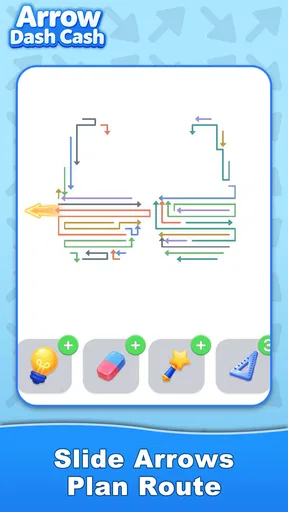
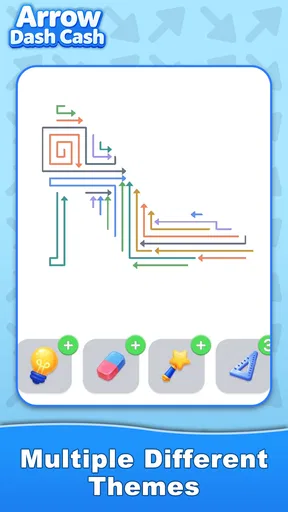
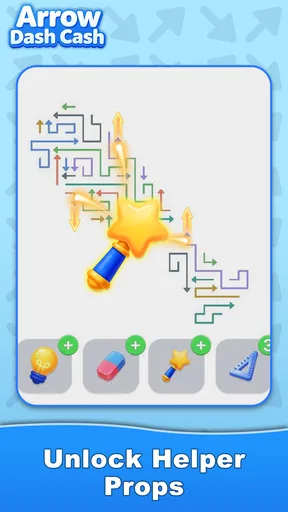
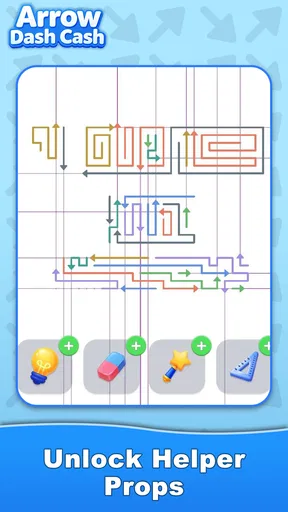
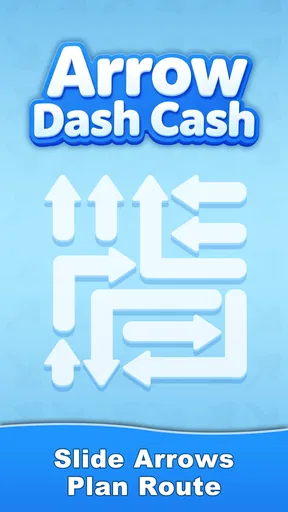
Arrow Dash Cash is a small, focused casual game built around one central idea: arrows move in the direction they are pointing, and I have to clear a route by choosing the correct order. That sounds simple, but the appeal comes from turning a basic visual rule into a short chain of decisions. I look at the board, identify which arrow can move safely, and try to avoid creating a blockage for the pieces that need to follow.
After spending time with it, I see the game as a good fit for people who enjoy compact logic challenges rather than long campaigns or complicated controls. It is free, aimed at Everyone, and developed by Kashif Iqbal. The current release is version 202600701-1723, and it runs on devices using Android 7.1 or later. Those details make it accessible to a wide range of Android users, while the straightforward design keeps the learning curve gentle.
The important thing is to approach it as a puzzle about planning under pressure, not as an action game. The arrows may move quickly once a decision is made, but the real work happens before the tap. I found myself scanning the available paths, checking which direction each piece faced, and resisting the temptation to move the first arrow that looked convenient.
How the arrow-order puzzle works in practice
The store summary describes the core rule accurately without explaining why it can become engaging: every arrow wants to travel in its own direction, and the route has to be clear. In practical terms, each move changes the space available for the remaining arrows. A choice that looks harmless in isolation can make the next move impossible, so the board rewards attention more than speed.
My preferred way to approach a level is to begin with the arrows that have the cleanest exit. I then work backward from the crowded areas, asking which piece must move before another one can pass. This is more reliable than simply following the most obvious arrow. When several directions appear open, I look for the move that preserves the largest number of future options.
That habit is one of the first useful lessons the game teaches. A clear path is not always the shortest-looking path. Sometimes an arrow near the edge should wait because moving it early removes a useful visual reference. In another position, a central arrow needs to go first because leaving it in place blocks several others. The challenge comes from recognizing these relationships before committing.
The controls are easy to understand, which is exactly what I want from a casual puzzle. There is no need to learn a large command set or remember complicated gestures. That simplicity also means the game has to earn my attention through the arrangement of the arrows. When the layout creates a genuine ordering problem, the minimal control scheme feels elegant. When the answer is immediately visible, the experience becomes more like a quick tap exercise.
Worth Reading Before You Choose

EA SPORTS FC Mobile 26 Is a Bigger Football Game, but It Takes Time

Flipboard Shows What News Apps Must Do Beyond the Feed

Switching to Android Auto Means Rethinking Your Driving Routine

Google Calendar Makes a Crowded Week Easier to Manage

Ludo King Makes the Most of the Minutes Between Plans

Baby Panda World Brings Quick Play to Modern Phones, but Its Game Library Feels Busy
I would not recommend rushing through the opening move just because the game looks relaxed. A short pause to inspect the whole board often saves several mistaken attempts. I also found it useful to separate arrows into three groups: those with open routes, those dependent on another arrow moving first, and those that are dangerous because they sit in a crowded lane. This informal grouping makes the puzzle easier to read without turning it into a formal system.
Why the simple rule still creates pressure
The pressure in Arrow Dash Cash does not come from a complicated story or a large collection of mechanics. It comes from commitment. Once I send an arrow along its direction, the board changes, and I have to live with the consequences. That makes even a short puzzle feel more deliberate than its casual label might suggest.
For an everyday example, I can imagine opening it while waiting for a coffee or sitting on public transport. A round can serve as a brief mental reset because the objective is immediately understandable. At the same time, I would not use it when I want a completely passive distraction. The game asks me to pay attention, especially when several arrows overlap or when the correct sequence is not obvious at a glance.
One practical tip is to inspect the destination area rather than only the arrow itself. The direction of travel tells me where a piece wants to go, but the surrounding space tells me whether that movement is safe. I also try not to treat an apparently empty lane as permanently available; another arrow may need it later. Thinking about the next two moves, instead of only the next one, makes a noticeable difference.
Another useful approach is to identify dependency pairs. If one arrow is positioned in the path of another, I ask which one has a genuine exit and which one is waiting for space. This prevents random tapping and turns the level into a small scheduling problem. It is a non-obvious strength of the design: the game can encourage orderly thinking without explaining a long tutorial.
Progress, repetition, and the feeling of improvement
The satisfaction here comes from recognizing patterns in my own mistakes. If I fail because I moved a flexible arrow too early, I can adjust that habit on the next attempt. If I misread a blocked route, I know to inspect the destination area more carefully. That kind of improvement feels personal because the game’s rule is stable while my understanding becomes sharper.
There is also a trade-off. A puzzle based on one main interaction can become repetitive if the layouts do not keep asking fresh questions. I would enjoy the game most in short sessions, where the familiar rule remains pleasant rather than becoming something I play mechanically. People looking for a large progression system, character development, or a broad variety of mechanics may find the experience too narrow.
The store summary does not promise a narrative campaign or a deep collection of modes, and I think that is useful context when deciding whether to install it. I would choose this over a more elaborate casual game when I want immediate logic play. I would choose a different option when I want social competition, a story, rich customization, or a long-term project that occupies many hours at a time.
For players who dislike failure, the best mindset is to treat an unsuccessful sequence as information. The arrows show exactly where the plan went wrong, so I can usually identify the decision that caused the blockage. That makes the game more forgiving psychologically, even when the board itself does not forgive careless ordering.
Fairness, spending, and what I can responsibly judge
Arrow Dash Cash is listed as free, which removes the basic price barrier to trying it. That matters for a casual game whose main appeal is quick experimentation: I can see whether the arrow-order mechanic suits me without committing to an upfront purchase. The age rating of Everyone also presents it as a broadly accessible choice for general audiences.
When it comes to spending, I prefer to be precise. The confirmed product details establish that the game is free, but they do not establish a purchase structure that I can describe confidently. I therefore would not tell a reader that it has paid boosts, subscriptions, cosmetic items, energy limits, or a particular advertising model. Those systems should be checked directly in the current app experience before anyone makes a decision based on them.
That uncertainty does not make the game untrustworthy by itself; it simply limits what I can promise about the commercial side. My practical advice is to install it only if the core puzzle sounds appealing, rather than assuming that free automatically means completely frictionless. If a player is especially sensitive to interruptions or optional spending, checking the in-game presentation before settling into a long session is sensible.
From a fairness perspective, the central puzzle idea appears naturally suited to skill-based play because the outcome depends on reading directions and selecting an order. The important qualification is that I cannot use that observation to claim anything about every possible progression or monetization detail. A fair core mechanic can still be surrounded by systems that change the experience, so I keep my judgement focused on what is clear: the challenge is understandable, and success should come from making the correct sequence.
The game has reached over one hundred thousand installs, which suggests that the compact format has found a meaningful audience. I treat that as a sign of interest rather than proof of quality. For me, the stronger evidence is whether the individual boards make me think, whether mistakes teach me something, and whether the game remains enjoyable after the first novelty fades.
Who should try it, and who should skip it
I would recommend Arrow Dash Cash to someone who enjoys visual puzzles, short decision-making sessions, and rules that are easy to learn but occasionally tricky to apply. It is particularly suitable for players who like working out dependencies: which piece moves first, which lane must remain open, and how one action affects the rest of the board.
It is also a reasonable choice for families looking for an accessible casual game, since the listed age category is Everyone and the main idea can be explained in one sentence. Younger players may still need help with planning rather than controls, while adults may appreciate it as a brief concentration exercise. I would keep expectations focused on puzzle solving instead of assuming that the age rating means every board will be effortless.
I would skip it if my priority were fast reflex competition. The arrows may create a sense of movement, but the meaningful skill is choosing the order, not reacting to opponents or mastering rapid input. I would also skip it if I wanted a rich story, a large range of activities, or a strong social layer. Those are not weaknesses in the narrow puzzle concept; they are reasons the game may not match a particular player’s taste.
Compared with the usual alternatives in the casual puzzle category, its advantage is concentration. Many casual games rely on matching, collecting, endless running, or rapidly repeating a familiar action. This one asks me to stop, inspect, and sequence. The trade-off is variety: a more feature-heavy puzzle title may offer a broader sense of progression, while this game’s identity depends heavily on how satisfying the arrow layouts are.
Device fit and practical expectations
The minimum requirement of Android 7.1 or later is helpful for people using older compatible phones. I would still judge the experience on the actual device rather than assuming that an older operating system guarantees identical smoothness everywhere. Since the game’s appeal rests on reading the board clearly, screen size and visibility matter more to me than raw technical ambition.
On a smaller display, crowded arrows may require more careful inspection, especially if several paths intersect visually. I would play with the screen clean and at a comfortable brightness so that direction cues remain easy to distinguish. This is a small but meaningful workflow improvement: the game is about spatial reading, so reducing visual distractions can make the puzzle feel fairer.
The listed release date is Jul 1, 2026, and the current version is 202600701-1723. Those details help identify the edition being discussed, particularly for readers comparing what they see on their own devices. I would still look at the version shown on the download page before installing, since mobile games can change over time and the exact build matters when troubleshooting an unexpected difference.
My trust verdict after weighing the trade-offs
My main reason to recommend it is the clarity of its central decision. I always know what I am trying to solve: arrows need room to travel, and the order matters. That makes the game easy to pick up while leaving enough room for careful planning. The best moments arrive when a board initially looks tangled, then becomes manageable after I identify the one move that unlocks everything else.
My reservation is equally clear. A single-mechanic casual game lives or dies by the quality and variety of its layouts. If I am hoping for a deep system, extensive content, or a broad set of activities, this is not where I would look first. Its strength is focus, and focus can feel repetitive when I am in the mood for something more expansive.
I also keep the free label in its proper perspective. It makes trying the game easy, but it does not by itself answer every question about the broader app experience. I would make a personal decision after seeing how the current build handles interruptions and optional spending, rather than relying on assumptions. That is the fairest way to evaluate a free casual title.
Overall, Arrow Dash Cash is worth a try for Android users who want a compact, readable logic game and enjoy planning several moves ahead. Kashif Iqbal’s concept is simple enough for immediate understanding, yet it can create genuine tension when paths compete for space. I would recommend short, attentive sessions, using the dependency and destination checks described above. If that style of thinking sounds satisfying, the game has a clear reason to earn a place on your phone; if you need variety, competition, or a substantial long-term progression system, a different casual game will likely serve you better.
Pros
- Simple controls make it easy to start playing immediately.
- Short rounds are convenient for quick gaming sessions.
- Bright visuals make the action easy to follow.
- Lightweight gameplay should run well on many devices.
- Reward-focused progression can encourage repeat play.
Cons
- Gameplay may become repetitive after extended sessions.
- Frequent ads can interrupt the flow between rounds.
- Cash-related rewards may have strict eligibility conditions.
- Progress can feel slow without repeated play.
- An internet connection may be required for some features.
FAQs for Arrow Dash Cash
What is Arrow Dash Cash, and how does the game work?
Arrow Dash Cash is a casual arcade-style game built around quick reactions, timing, and directional control. During a session, you guide or launch arrows through changing obstacles and try to achieve the highest possible score. The gameplay is generally easy to understand, but later stages can become more demanding as speed, patterns, and hazards increase. It is designed for short play sessions and straightforward entertainment.
Can I really earn money or cash rewards by playing Arrow Dash Cash?
The name may suggest that the game provides real-money rewards, but players should read the current reward rules carefully before assuming they can withdraw cash. In many similar apps, advertised prizes may depend on reaching specific milestones, completing conditions, watching advertisements, or meeting eligibility requirements. Reward availability can also vary by country. Treat the cash feature as optional and verify the official terms before investing significant time.
Is Arrow Dash Cash free to download and play?
Arrow Dash Cash may be available to download without an upfront purchase, allowing users to try the main gameplay at no initial cost. However, free games commonly include advertising, optional in-app purchases, or features that require additional progress. Before downloading, check the Google Play Store or App Store listing for the latest pricing, advertising information, purchase options, and supported devices, since these details can change with updates.
Does Arrow Dash Cash require an internet connection?
The basic arrow gameplay may work during some offline sessions, but an internet connection can be necessary for advertisements, reward verification, account synchronization, updates, leaderboards, or redemption-related features. If you plan to play without mobile data, test the game after disabling your connection rather than assuming every function will work. Availability of offline play may also differ between Android and iOS versions.
Is Arrow Dash Cash safe for children and safe to install?
Before installing Arrow Dash Cash, review its store rating, developer information, permissions, privacy policy, and content classification. The game itself may be simple and suitable for casual players, but advertisements, external links, optional purchases, and reward-related prompts deserve attention, especially on a child’s device. Use only the official Google Play or App Store listing, avoid modified APK files, and enable purchase restrictions when necessary.


